
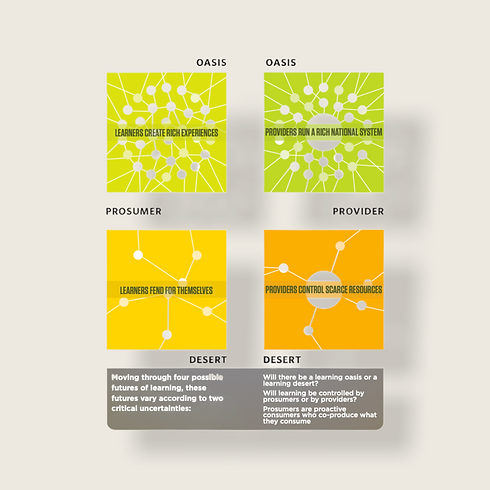
OUR PROVISIONAL MODEL FOR COMMUNITY ENGAGEMENT:
A Vibrant Learning Grid!
We Believe KnowledgeWorks Got it Right!
Future approaches to learning need to
educate the whole person,
personalize learning in community,
create flexible approaches to learning and coordination,
ground systems change in equity, and
reflect new definitions of success.
Today’s education leaders and innovators need to play a central role in shaping the future of learning. Striking the delicate, shifting balance between moving toward a future vision while stewarding today’s organizations and responding to current reality is possible.

ADVOCACY: G.R.A.S.P.
Ensuring that All Voices are Included
GRAND CHALLENGES
Advocacy is an essential pillar of our Engineering and Social Justice Grand Challenge Movement. There is strength in numbers, and we work to inform and encourage others to take a stand for what they believe in. Want to learn more about the Grand Challenges?
THE MAHOMET AQUIFER PROJECT
By Jacquelyn Potter, Sierra Club Prairie Group
Water is life. That message has resonated in the hearts and minds of many over the past year as many issues with regard to water use and conservation, water pollution and safety that have come about. However, through the unfolding events, it has become clear that a new shift toward reverence for water-as-life-giver is happening. People are waking up and communities are beginning to come together and mobilize to mitigate damage to water sources and protect them from future potential threats. Education of the public is key, and it is this fundamental role of education that is the root for growth in community awareness of environmental issues. This encompasses many different modes, as science, ecology, politics, sociology and the arts all play important roles in educational expression. There is a definite need for multidisciplinary understanding of issues and community space to bring all those forces together.
With that in mind, Laura Kalman has brought forth such a space, the first expression of which focuses on the issue of water, named the Mahomet Aquifer Project. The Mahomet Aquifer Project (MAP) is a brilliant scale model exhibit of a section of the Mahomet Aquifer, showing all the layers as they would appear if one was immersed deep within the aquifer. The MAP is a STEM experiment designed for middle school students. Students collected “found materials” during winter 2016 and attended two building days where they learned about the aquifer, mapping, scaling, packing algorithms, permeability, porosity, and sustainability as it relates to careers in civil engineering. The MAP was built with found materials (teaching repurposing and upcycling) such as discarded cardboard and plastic water bottles that have been patterned and layered very carefully to show the actual layers within the Mahomet Aquifer. Since the construction began many student groups have held field trips inside the aquifer to watch construction. Since February 2017, UI-UC students have attended group “build nights” helping prepare the found materials and construct the exhibit, during which they also have learned about the importance of ground water and the aquifer to Central Illinois. The MAP exhibit has begun its “interactive” phase of building, with a display of streaming data collected by sensors located in the Sangamon River Basin, which will be represented by the lights and coded by a local high school robotics team to show how different simulations affect the aquifer. This is perhaps the most brilliant facet, as the strung lights used with the water bottles make the water sections glow and twinkle in the darkened “underground” area, adding the dimension of life within the water, which gives the feeling you are witnessing sacred space.
The MAP exhibit had a soft opening with “Lego Day” (part of the Boneyard Art Festival), and will officially open on Earth Day (April 22) also in conjunction with “March for Science Day.” The march ends in the parking lot immediately out front of the studio and people can attend then attend the exhibit. The exhibit has been designed to host special events and there are adjacent rooms for group meetings, presentations, displays and tabling.
The Mahomet Aquifer Project could not have come at a better time. It is now that we must reach out to communicate the significance and urgency of protecting our environment. The community space that the MAP is housed within embraces multiple learning and intelligence theory and bridges multiple disciplines of science, engineering, environmental politics and justice, sociology and the arts. It informs and inspires all age groups. A more informed and inspired public is indispensable to maintaining a discerning and caring eye on events and taking action through participation in the decision-making process that can affect our environment. What better way to begin this process than a cross-disciplinary and visually-stunning exhibit that weighs with an immediate impact on both in mind and heart the clear message that water is life.