

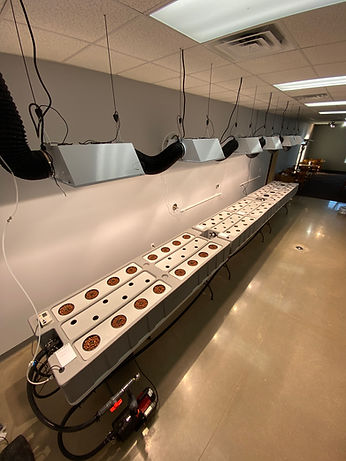
Hybrid Aeroponics/Hydroponics
Patent # 12096727
Phone:
440-382-6833
Email:
Address:
2665 E Park Rd
Metropolis, Illinois
Patent Award Date:
September 24, 2024
Welcome to Food Security
Food security means that all people, at all times, have physical and economic access to sufficient, safe, nutritious, and culturally acceptable food that meets their dietary needs and preferences for an active, healthy life. [Nature+2Engineering LibreTexts+2]
Core Dimensions (Pillars) of Food Security
-
Availability – adequate supply of food (through production, processing, distribution). [Engineering LibreTexts+1]
-
Access – individuals and households have the resources (economic, social, physical) to obtain food. [worldfoodprize.org+1]
-
Utilization – food is properly used: safe, nutritious, prepared in ways that support health (including water, sanitation, and dietary quality). [Engineering LibreTexts+1]
-
Stability – access and availability are reliable over time, even when markets, climate, or crises cause disruption. [Engineering LibreTexts+1]
Why It’s a “Grand Challenge” in Engineering / Global Systems Context
As identified by frameworks such as National Academies of Sciences, Engineering, and Medicine, a major “Grand Challenge” is to sustainably supply food, water, and energy for a growing global population — while minimizing environmental impact, ensuring resilience under changing climate, and preserving resource sustainability. [nap.nationalacademies.org+1]
Meeting this challenge requires not just increasing food production, but reinventing the entire food system: from efficient, environmentally responsible production (for example indoor/urban agriculture), to equitable access, safe and nutritious supply chains, and robustness against shocks (climate, economic, social).

Automated Underground Garden Timeline
Year 3-5: Legacy & Sustainability
January 2028 - 2030
Year 2: Expansion & Impact:
January 2027 - 2028
Year 1 – Deployment & Launch:
January 2026 - 2027
Evaluate long-term outcomes on food security, youth engagement, and family and community violence prevention. Codify best practices for replication nationwide and create a model for sustainable urban food oases, ensuring enduring impact beyond the initial funding period.
Refine educational curricula, and establish community partnerships. Track food production, youth participation, and early indicators of community resilience and reduced family stress.
Install the first full-scale Automated Underground Garden in downtown Champaign, integrate cloud-controlled systems, and begin the year-round growing cycle. Launch STEAM learning programs for students and families.
Automated Underground Garden:
Transforming Urban Food Security and STEM Learning
The Automated Underground Garden is a bold initiative from the CS+X Foundation that turns innovative indoor farming technology into a year-round source of fresh, healthy food, while engaging youth and families in hands-on STEAM learning. Building on the success of our Safe Water Grand Challenge, this next Grand Challenge tackles food security in urban communities by creating “food oases” that nourish both bodies and minds.
By combining patented, cloud-controlled grow chambers with interactive educational programming, the garden ensures that children, teens, and families can grow, monitor, and harvest crops like tomatoes, peppers, pumpkins, leafy greens, herbs, and even high-yield plants such as cassava—regardless of the season. The system’s perpetual grow technology is particularly vital during the summer months when traditional school-year programs slow down, allowing generations of students informal access to sustainable indoor farming.
Beyond food production, the project fosters community resilience, family engagement, and safer neighborhoods. Research shows that improving access to nutritious food and hands-on learning opportunities can help reduce family stress, build stronger social bonds, and support youth development—key factors in preventing domestic and community violence.
Your contribution to our $2.5M capital raise will fund:
-
Full-scale deployment of a 10,000 sq. ft Automated Underground Garden.
-
STEAM-focused programs that teach students how to operate high-tech indoor farms, collect and analyze data, and explore careers in science, technology, and agriculture.
-
Community outreach and partnerships to ensure equitable access and sustained engagement.
-
Research and innovation to expand crops, optimize yields, and develop models for other urban communities nationally.
A gift to the Automated Underground Garden creates immediate impact—fresh, nutritious food and enriched learning opportunities—and establishes a long-term legacy: safe, empowered, and resilient urban communities where innovation, education, and nourishment go hand-in-hand with violence prevention.

2026 Urban Farming Funding Opportunities
1. Rural & Urban Food Security Innovation (RFSI) — Automated Underground Garden to address community nutrition, food access, and family stability.
— Up to $3,000,000
— No cost-share required
— Supports large-scale urban food security projects; perfect for scaling
2. Experiential Learning for Emerging and Novel Technologies (ExLENT) — Ideal for engaging youth and families in hands-on science, technology, and agriculture learning with automated indoor farming.
— Up to $3,500,000 (large-scale public engagement projects)
— No cost-share required
— Supports informal STEM/STEAM learning;
3. Urban, Indoor, and Emerging Agriculture (UIE)— Supports automated, cloud-controlled grow chambers and operational scale-up.
— Up to $1,000,000
— No cost-share required
— Core funding for indoor/urban agriculture deployment;
4. Agriculture and Food Research Initiative (AFRI)— Supports research, innovation, and optimization of controlled-environment agriculture systems, including growing cassava or other crops.
— $50,000–$500,000 depending on subprogram
— May require partial cost-share depending on RFA
5. Urban Agriculture and Innovative Production (UAIP) — Useful for community-level implementations, pilot installations, and education/outreach at urban farming sites.
— $100,000–$250,000
— No cost-share required
6. USDA NIFA SBIR/STTR — Small Business Innovation Research / Technology Transfer. For R&D and commercialization of patented automated grow chambers, including adaptation for crops like cassava. Can complement nonprofit deployment with scalable tech.
— Phase I: $100,000–$175,000;
— Phase II: ~$600,000
— No cost-share required
7. Urban Farming Innovation Grant — (Potential state/federal programs, e.g., DOE, USDA, or local urban-ag innovation funding) Example: [DOE SBIR / ARPA-E Urban Ag] or state equivalents. Can be used to enhance indoor growing, efficiency, or energy management of Automated Underground Garden.
— $250,000–$1,000,000 depending on program
— May require cost-share depending on solicitation
— Supports technology-driven urban farming innovation, automation, and sustainability;